
Korean sunscreens often feel lighter because many of them are designed to work like the final step of a daily skincare routine.
Think fluid lotions, gel-creams, soft emulsions, and formulas that are meant to sit comfortably under makeup rather than feel like something you packed for a beach day.
The low-white-cast finish many Korean sunscreens are known for also has a lot to do with the UV filters and the rest of the formula.
But that does not mean every Korean sunscreen disappears perfectly on skin—or that Korean automatically means better.
There is also a regulatory reason the products can feel and look different.
Korea treats sunscreen as a type of functional cosmetic, while the United States regulates sunscreen as an over-the-counter drug.
That affects which UV filters can be used, what has to appear on the label, and whether a Korean formula can be sold unchanged in the U.S.
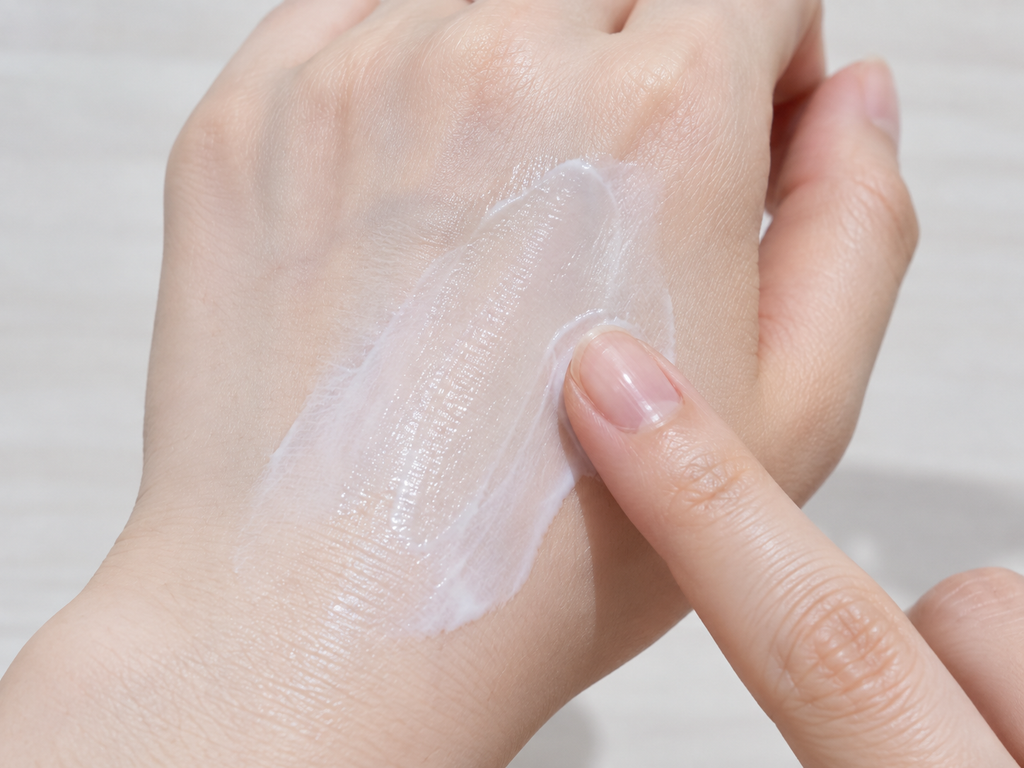
So, Why Do Korean Sunscreens Feel Different?
There is no single ingredient that makes a sunscreen “feel Korean.”
The texture comes from the entire formula.
Water and oil phases, solvents, emulsifiers, film-formers, powders, humectants, and emollients all affect how a sunscreen spreads, dries, shines, pills, and sits under makeup.
A big part of the difference is simply what many Korean facial sunscreens are trying to do.
They are often positioned as something you will wear every morning after skincare and before makeup.
That gives brands a strong reason to make them feel more like a light lotion, essence, or gel-cream than a heavy outdoor sunscreen.
Moisturizing ingredients can help create that skincare-like feel, but they do not replace the UV filters.
The filters provide the protection.
The rest of the formula determines whether putting it on every morning feels easy or annoying.
“Korean sunscreen” is still a very broad category.
Tone-up sunscreens can look visibly pale.
Mineral formulas may feel richer.
Water-resistant sports sunscreens often need a stronger film and may not feel nearly as weightless.
So the moisturizer-like reputation is real as a market trend, not a rule for every sunscreen made in Korea.
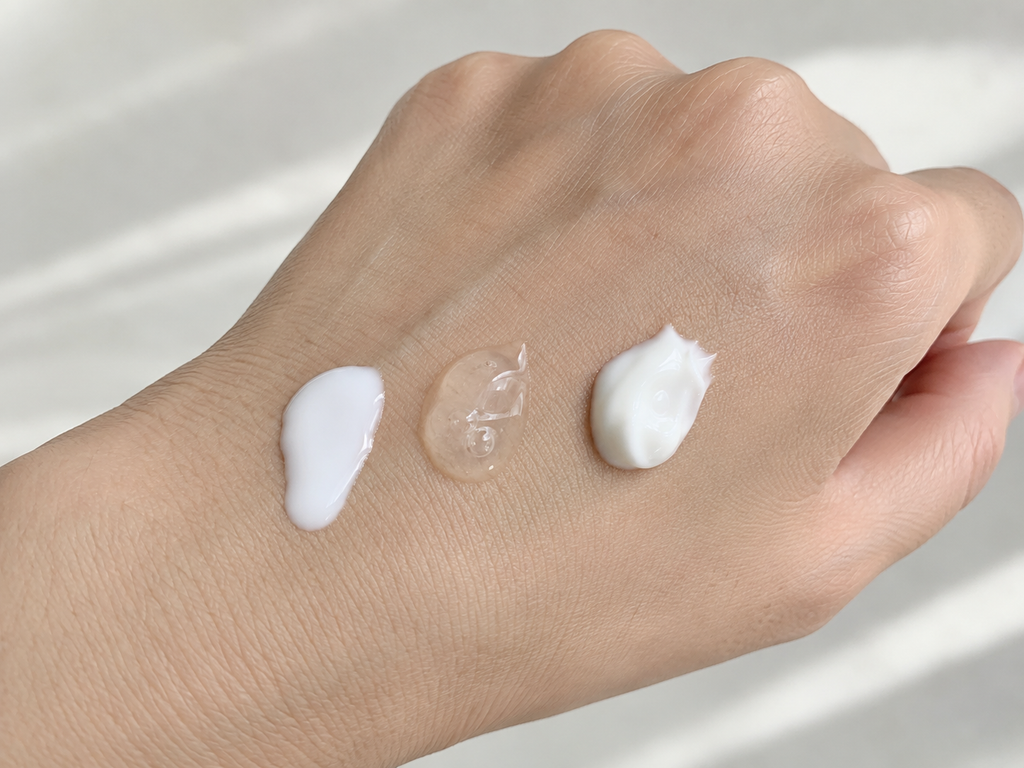
Why Do Many Korean Sunscreens Leave Less White Cast?
White cast is often associated with mineral filters such as zinc oxide and titanium dioxide.
But even that explanation can get oversimplified.
Particle size, coatings, dispersion, tint, powders, and the rest of the formula all affect how visible a sunscreen looks once it is on the skin.
And mineral filters are not simply tiny mirrors sitting on top of the face.
Research shows that zinc oxide and titanium dioxide protect mainly by absorbing UV, with some scattering and reflection.
Many popular Korean daily sunscreens rely heavily on organic UV filters that do not begin as visible white mineral powders.
That can make a transparent finish easier to achieve.
Newer filter combinations also give formulators more options for building UVA and UVB protection without depending on a large visible mineral load.
Still:
organic does not automatically mean invisible, and mineral does not automatically mean ghostly.
A formula can still leave residue.
Powders can collect around facial hair.
A tinted mineral sunscreen may blend better than an untinted one.
And skin tone matters a lot.
A cast that looks barely noticeable on one person may be very obvious on someone else.
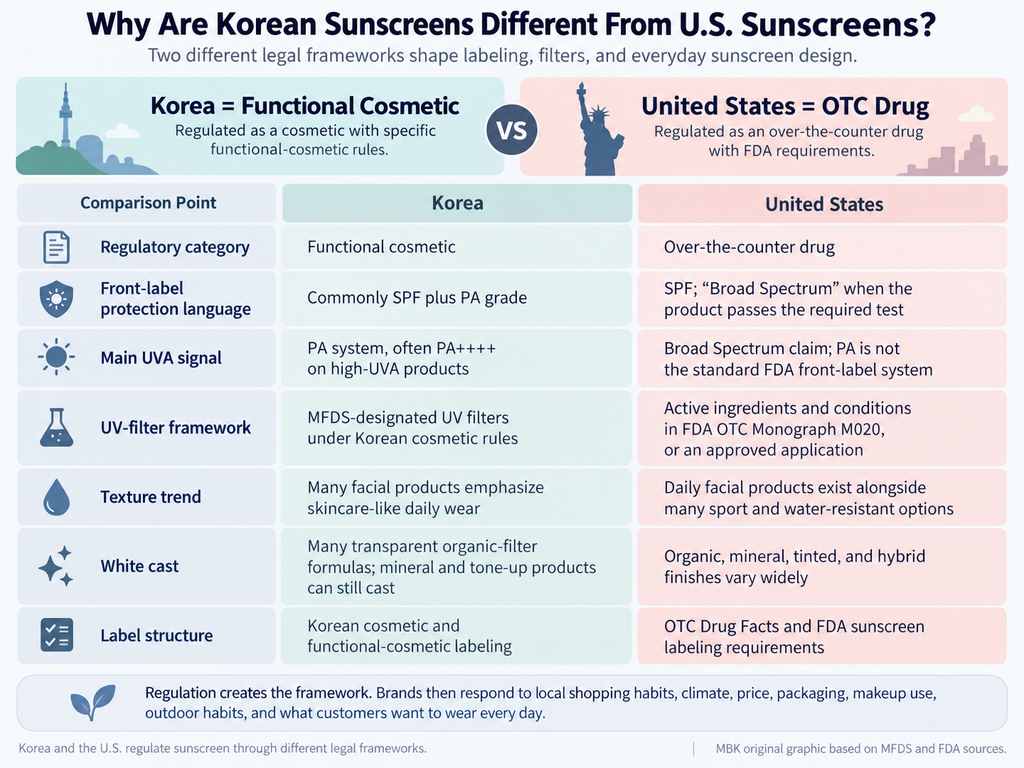
Why Are Korean Sunscreens Different From U.S. Sunscreens?
The biggest structural difference is the legal category.
In Korea, products that protect the skin from UV are regulated as functional cosmetics. The MFDS explanation describes the evaluation or reporting framework for their safety and effectiveness.
The Ministry of Food and Drug Safety, or MFDS, has requirements around safety, effectiveness, sunscreen claims, SPF, and UVA protection.
In the United States, sunscreen is regulated as an OTC drug.
That means a sunscreen sold with sunscreen claims in the U.S. has to fit FDA requirements or have an approved drug application.
The OTC monograph framework covers things such as active ingredients, permitted concentrations, testing, claims, and Drug Facts labeling.
| Comparison | Korea | United States |
|---|---|---|
| Regulatory category | Functional cosmetic | Over-the-counter drug |
| Front-label protection language | Commonly SPF plus PA grade | SPF; “Broad Spectrum” when the product passes the required test |
| Main UVA signal | PA system, often PA++++ on high-UVA products | Broad Spectrum claim; PA is not the standard FDA front-label system |
| UV-filter framework | MFDS-designated UV filters under Korean cosmetic rules | Active ingredients and conditions in FDA OTC Monograph M020, or an approved application |
| Texture trend | Many facial products emphasize skincare-like daily wear | Daily facial products exist alongside many sport and water-resistant options |
| White cast | Many transparent organic-filter formulas; mineral and tone-up products can still cast | Organic, mineral, tinted, and hybrid finishes vary widely |
| Label structure | Korean cosmetic and functional-cosmetic labeling | OTC Drug Facts and FDA sunscreen labeling requirements |
That does not mean Korean regulators care about texture while U.S. regulators do not.
Regulation creates the framework brands have to work inside.
Then brands respond to local shopping habits, climate, price, packaging, makeup use, outdoor habits, and what customers actually want to put on their face every day.
Why Can’t You Always Buy the Exact Same Korean Sunscreen in the U.S.?
Seeing a Korean sunscreen on an American marketplace does not automatically mean that exact formula is officially sold for the U.S. market.
If a brand wants to market a product in the United States with sunscreen claims, it has to meet U.S. drug requirements.
A Korean domestic formula may use a UV-filter combination that does not fit the current U.S. OTC monograph.
When that happens, a brand may:
- Create a different U.S. formula
- Change the claims
- Delay official U.S. distribution
- Decide not to sell the sunscreen officially in the U.S.
The opposite assumption can also be wrong.
Different packaging does not automatically prove the formula changed.
If you really want to know whether two versions are the same, compare the full ingredient or active-ingredient list, the official country-specific product pages, and the responsible distributor.
Do not rely on a marketplace title that says things like “Korean version” or “original formula.”
Cross-border sellers and parallel imports can make a product look widely available in America even when it does not have official U.S. distribution.
That is mainly an availability and regulatory distinction—not proof that one version is better.
What About the Newer UV Filters?
This is one section where older sunscreen articles can already be out of date.
On June 9, 2026, the FDA announced the addition of bemotrizinol, also known as BEMT, to the U.S. OTC sunscreen monograph.
Its INCI name is Bis-Ethylhexyloxyphenol Methoxyphenyl Triazine.
The corrected final order issued June 10, 2026 permits up to 6% under its specified conditions. The concentration limit alone does not make every finished formula eligible.
That was a major change because it was the first new active ingredient added to the U.S. OTC sunscreen monograph since the late 1990s.
The Korean functional-cosmetic standards, Annex 4, list BEMT alongside DHHB and EHT. Permission in Korea does not establish the same permitted combinations, concentrations or finished-product requirements in the U.S.
Korea also permits filters commonly seen in modern sunscreen formulas such as:
- Diethylamino Hydroxybenzoyl Hexyl Benzoate (DHHB): mainly used for UVA protection and commonly associated with the trade name Uvinul A Plus
- Ethylhexyl Triazone (EHT): a strong UVB filter commonly associated with the trade name Uvinul T 150
- Bemotrizinol (BEMT): a broad-spectrum organic UV filter commonly associated with Tinosorb S
Trade names and ingredient names are not interchangeable on every label, so the INCI name is the safer thing to check.
The verified U.S. change discussed here is the June 2026 BEMT order. It is not blanket permission to sell any Korean sunscreen unchanged in the U.S. For a specific product, compare the country-specific label and active ingredients rather than relying on a filter’s trade name.
So the U.S.–Korea filter gap became smaller, but it did not disappear.
And filters are only part of the story.
A formulator still has to make those ingredients dissolve or disperse properly, keep the formula stable, create an even film, pass finished-product protection testing, and make the product pleasant enough that people will actually use it.
What Does SPF50+ PA++++ Mean?
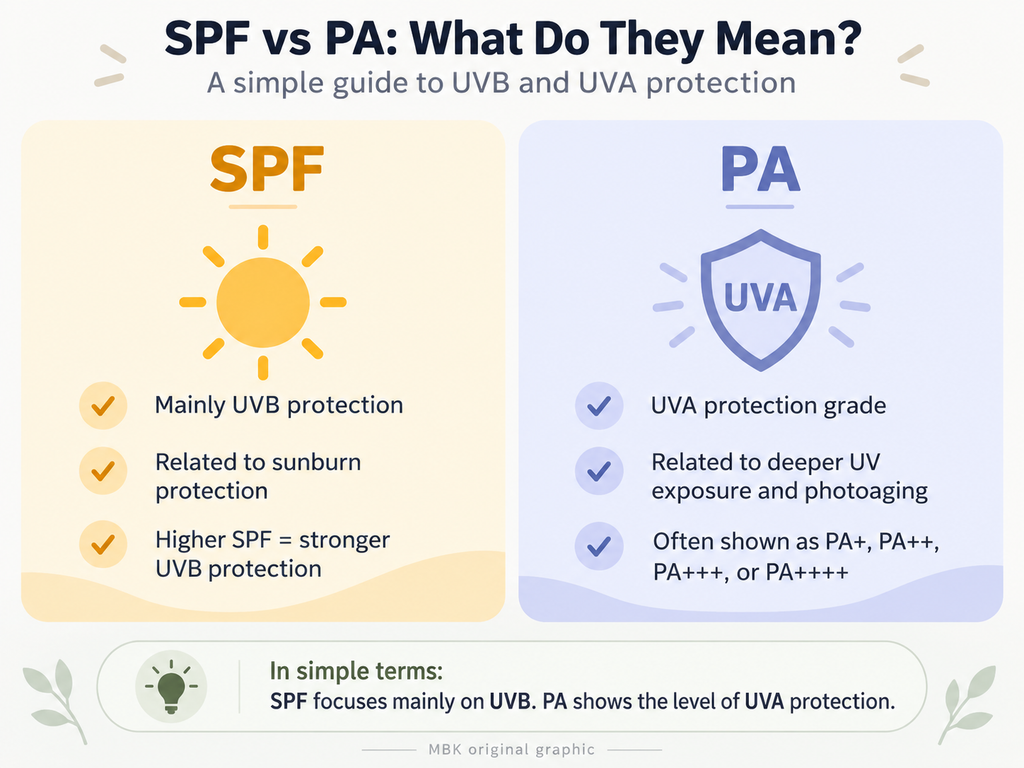
SPF is a tested measure mainly linked to protection against sunburn, which is driven largely by UVB.
It is not a timer.
SPF50 does not mean you can simply stay outside 50 times longer and forget about how much sunscreen you applied, sweating, rubbing, water exposure, or reapplication.
PA is a UVA protection grading system.
The plus signs represent grades based on measured UVA protection.
PA++++ is the highest grade in the four-plus PA system and generally corresponds to a UVA protection factor of 16 or higher.
So when you see:
SPF50+ PA++++
you are looking at a product with a high tested SPF category and the highest PA UVA grade.
What that label does not tell you is:
- Whether the texture is light
- Whether it leaves a white cast
- Whether it is water-resistant
- Whether it works well under makeup
- Whether it is the right choice for swimming or hiking
In the U.S., you are more likely to see Broad Spectrum rather than a PA grade.
FDA uses that consumer-facing claim when a sunscreen passes the required broad-spectrum testing.
Does Lightweight Texture Mean Better Sun Protection?
No.
A sunscreen can feel like a serum and still test to a high protection level.
A thick cream can also test to a high protection level.
Texture and tested protection are separate questions.
A pleasant formula does have one practical advantage: people may be more willing to apply it evenly and use it consistently.
But a comfortable finish does not prove stronger protection.
And applying one very thin swipe does not magically become enough just because the tube says SPF50+.
Follow the product directions and check whether it is meant for swimming, sweating, or outdoor use.
No sunscreen is truly waterproof.
In the U.S., water-resistant sunscreens specify whether testing supports 40 or 80 minutes of water resistance.
Korean packages may use wording such as 워터프루프, but you still need to read the exact claim and directions rather than assuming it means unlimited protection in water.
Why Do U.S. Shoppers Like Korean Sunscreens?
A lot of the appeal comes down to ordinary everyday comfort.
English-language skincare discussions repeatedly mention the same things:
less grease, less visible cast, better layering under makeup, and a finish that does not make sunscreen feel like a special outdoor product.
Those comments are useful for understanding preference.
They are not scientific proof that Korean sunscreen is better.
There is also a catch.
A dewy sunscreen may be too shiny for oily skin.
A fragranced lotion will not suit everyone.
And the very light sunscreen you love for a day at the office may not be the product you want for swimming, hiking, or a long sweaty afternoon outside.
Your favorite daily sunscreen and your best beach sunscreen do not have to be the same tube.
Is Korean Sunscreen Better Than American Sunscreen?
“Better” only makes sense if you say better for what.
For commuting, makeup, school, office days, and everyday errands, a lightweight Korean facial sunscreen may be easier to wear.
For swimming, outdoor sports, heavy sweating, or long periods outside, a clearly labeled water-resistant sunscreen may make more sense.
That product could be Korean.
It could be American.
The country name alone does not make the decision for you.
U.S. brands also make elegant facial sunscreens.
And Korea sells richer creams, mineral formulas, tone-up products, and sport-focused sunscreens that do not fit the famous “weightless K-beauty sunscreen” image at all.
The useful takeaway is simpler:
Korea has an especially competitive market for comfortable daily facial sunscreen.
That is not the same as saying every Korean sunscreen protects better than every American one.
Should You Buy Sunscreen While Traveling in Korea?
If you enjoy comparing textures in person, Korea is a good place to do it.
Beauty stores can give you access to facial creams, essences, fluids, sticks, tone-up sunscreens, mineral formulas, and water-resistant options in one shopping trip.
Before buying, check:
- SPF and PA grade
- Water-resistance claims
- Face, body, or multi-use positioning
- Mineral, organic, or mixed filter type if that matters to you
- Expiration or use-by information
- Exact Korean product name and size
- Responsible seller or distributor
- Whether you are buying from an official or clearly authorized retailer
If you are shopping near a traditional market, MBK’s guide to Olive Young at Gwangjang Market explains that branch’s location and shopping setup.
Sunscreen can also appear in pharmacy skincare sections, but product selection varies by store. MBK’s Korean pharmacy skincare near Gwangjang Market gives more context before you assume every pharmacy carries the same products.
What to Look for on a Korean Sunscreen Label
| Korean wording | What it means | What to know |
|---|---|---|
| 자외선 차단 | UV protection / sunscreen function | Look for SPF and PA claims nearby |
| SPF50+ | High tested sunburn/primarily UVB protection category | It is not a time multiplier |
| PA++++ | Highest grade in the four-plus UVA system | It does not mean the product is water-resistant |
| 워터프루프 | Waterproof-style marketing wording | Check the exact tested claim and directions |
| 무기자차 | Common Korean shorthand for a mineral/inorganic-filter sunscreen | Usually points to zinc oxide and/or titanium dioxide; finish still varies |
| 유기자차 | Common Korean shorthand for an organic-filter sunscreen | Often translated as “chemical sunscreen,” though “organic UV filters” is more precise |
| 혼합자차 | Mixed or hybrid filter sunscreen | May combine inorganic and organic UV filters |
| 사용기한 | Use-by or expiration information | Do not buy a tube you cannot reasonably finish in time |
The Korean terms 무기자차 and 유기자차 are useful shopping shorthand.
They are not perfect explanations of how sunscreen filters work.
In particular, mineral filters do not simply act like tiny mirrors sitting on the skin.
Common Myths About Korean Sunscreen
Myth 1: Korean sunscreen never leaves a white cast.
False.
Mineral formulas, tone-up sunscreens, powders, residue, and poor dispersion can all create visible cast.
Skin tone and application amount matter too.
Myth 2: Korean sunscreen is always stronger than U.S. sunscreen.
False.
Country of origin does not replace finished-product testing.
Look at the protection claims and whether the product fits what you are actually doing.
Myth 3: All Korean sunscreens use the same newer filters.
They do not.
Korean brands use different mineral, organic, and mixed filter systems.
Myth 4: You cannot buy Korean sunscreen in the U.S.
Too broad.
Korean brands sell U.S.-compliant sunscreens, officially imported products exist, and cross-border sellers also list Korean domestic formulas.
Those are not all the same thing.
Myth 5: A lighter sunscreen provides less protection.
No.
Texture does not determine the tested SPF or UVA rating.
How the finished product tested—and how you actually apply it—matters much more.
Korean vs. U.S. Sunscreen at a Glance
| Feature | Korean market pattern | U.S. market pattern |
|---|---|---|
| Texture | Strong competition around light facial lotions, essences, and gel-creams | Wide range from daily facial fluids to heavier sport and beach products |
| White cast | Many transparent organic-filter options; mineral and tone-up casts still exist | Organic, mineral, tinted, and hybrid finishes vary widely |
| UV-filter availability | BEMT, DHHB, EHT, mineral filters, and other MFDS-designated options | OTC monograph now includes BEMT; DHHB and EHT remained outside it at the time of this update |
| Regulation | Functional cosmetic | OTC drug |
| UVA labeling | PA grades are common | Broad Spectrum is the standard consumer-facing FDA claim |
| Daily-use focus | Especially strong in facial K-beauty | Present, but shares shelf space with sport and outdoor positioning |
| Water resistance | Available, but check product by product | 40- or 80-minute claims are used when products pass FDA water-resistance testing |
| U.S. availability | Domestic Korean formula may lack official U.S. distribution or may be reformulated | U.S.-market version must meet U.S. drug requirements |
FAQ
Why are Korean sunscreens so lightweight?
Many Korean facial sunscreens are designed for daily skincare routines and makeup layering.
Light emulsions and the rest of the cosmetic formula create that feel.
Not every Korean sunscreen is lightweight.
Why do Korean sunscreens often have less white cast?
Many popular formulas use transparent organic UV-filter systems rather than depending heavily on white mineral powders.
Formula design, tint, application amount, and skin tone still affect the result.
Why are Korean sunscreen formulas different in the U.S.?
Sunscreen is regulated as an OTC drug in the U.S.
A U.S.-market product therefore has to meet FDA requirements for active ingredients, testing, claims, and labeling.
A brand may sell a different U.S. formula from its Korean domestic version.
Can I buy Korean sunscreen in America?
Yes.
But “available in America” could mean an official U.S. formula, an authorized imported product, or a cross-border marketplace listing.
Check the exact formula and seller.
Are Korean sunscreens better than U.S. sunscreens?
Not as a blanket rule.
Korean facial sunscreens are especially competitive when it comes to comfortable everyday texture.
For swimming or heavy sweating, a water-resistant product may matter more than whether it is Korean or American.
What does PA++++ mean?
PA++++ is the highest grade in the four-plus PA system for UVA protection and generally represents a UVA protection factor of at least 16.
It does not tell you anything by itself about texture or water resistance.
Is Korean SPF50 the same as U.S. SPF50?
Both are SPF claims related to standardized testing for protection against sunburn.
The surrounding regulatory and UVA-labeling systems differ, so look at the whole label rather than only the number.
Why do Korean sunscreens feel like moisturizer?
Many are built as daily facial emulsions with moisturizing, slip-enhancing, and texture-focused ingredients.
The UV filters provide protection.
The rest of the formula creates the skincare-like feel.
Do Korean sunscreens use different UV filters?
They can.
Korea permits filters such as DHHB and EHT that remained outside the current U.S. OTC sunscreen monograph at the time of this article’s regulatory check.
BEMT used to be another major difference, but FDA added it in June 2026.
Should I buy sunscreen in Korea?
It can be worth it if you want to compare many facial sunscreen textures in person.
Choose according to how you plan to use it—daily wear, sport, water exposure, makeup, finish—not simply because it is Korean.
Sources & Last Updated
Key official and technical references used for this article:
- FDA: Sunscreen—How to Help Protect Your Skin from the Sun
- FDA: Regulatory Actions on Over-the-Counter Sunscreen
- FDA Final Order OTC000039: Bemotrizinol
- FDA: Bemotrizinol Added to the OTC Sunscreen Monograph, June 2026
- Korean MFDS: Functional Cosmetics Approval Process
- Korean Cosmetics Act, English translation
- Korean official standards: UV-filter ingredients including BEMT and DHHB
- Korean official ingredient restrictions: EHT and other UV filters
- ISO 24442:2022: UVA protection-factor test method
- JCIA: SPF, PA, and water-resistance standards
- Peer-reviewed study: Mineral filters protect mainly by absorption
- Peer-reviewed research on sunscreen white cast
Consumer discussions were used only to identify recurring preferences such as low white cast, makeup compatibility, and moisturizer-like texture.
They were not used as evidence for scientific or regulatory claims.
Regulatory-source review: October 15, 2026. The FDA’s June release and corrected final order, MFDS functional-cosmetic guidance and the linked Korean filter standards were rechecked. The broader article was last edited September 20, 2026; this review did not test individual products or verify every brand’s U.S. distribution.
Regulations, formulas, packaging, and distribution can change.
Check the current official label and the country-specific brand page before buying.