
Korean fried chicken types go far beyond one dish with ten sauces pretending to be different.
The main styles range from whole, retro-style tongdak to plain fried chicken, sticky yangnyeom, soy garlic, green onion-topped padak, powder-seasoned chicken, and oven-roasted options.
Your best first order depends on what you actually like.
Choose plain fried chicken for crunch, yangnyeom for sweet heat, soy garlic for a savory-sweet glaze, or tongdak for an old-school market experience.
If choosing one feels unfair, Korea already has a solution: banban, or half-and-half chicken.
Which Korean Fried Chicken Types Should You Try First?
| If You Want… | Order This | What to Expect |
|---|---|---|
| The simplest, crispiest starting point | Classic fried chicken | Salty, crunchy, and sauce-free |
| Sweet and mildly spicy sauce | Yangnyeom chicken | Sticky, sweet, tangy, and usually less fiery than it looks |
| Savory sweetness with garlic | Soy garlic chicken | A glossy soy-based glaze with a garlicky finish |
| A retro market-style experience | Old-school tongdak | A smaller whole chicken with thin coating and crisp skin |
| A mild, sweeter flavor | Honey-style chicken | Sweet glaze or seasoning; the recipe depends on the shop |
| A bold snack-like seasoning | Cheese powder chicken | Sweet-savory powder over fried chicken |
| Fresh onion flavor and contrast | Padak | Fried chicken topped with thinly sliced green onion |
| Chicken without a deep-fried crust | Oven-roasted chicken | Roasted skin and a less batter-heavy texture |
| More than one flavor | Banban chicken | Two styles in one order, when the restaurant offers it |
If this is your first Korean chicken order, banban with classic fried and yangnyeom is an easy place to start.
You get both the crispy original and the sauced version without committing the whole order to one flavor.
1. Old-School Korean Tongdak
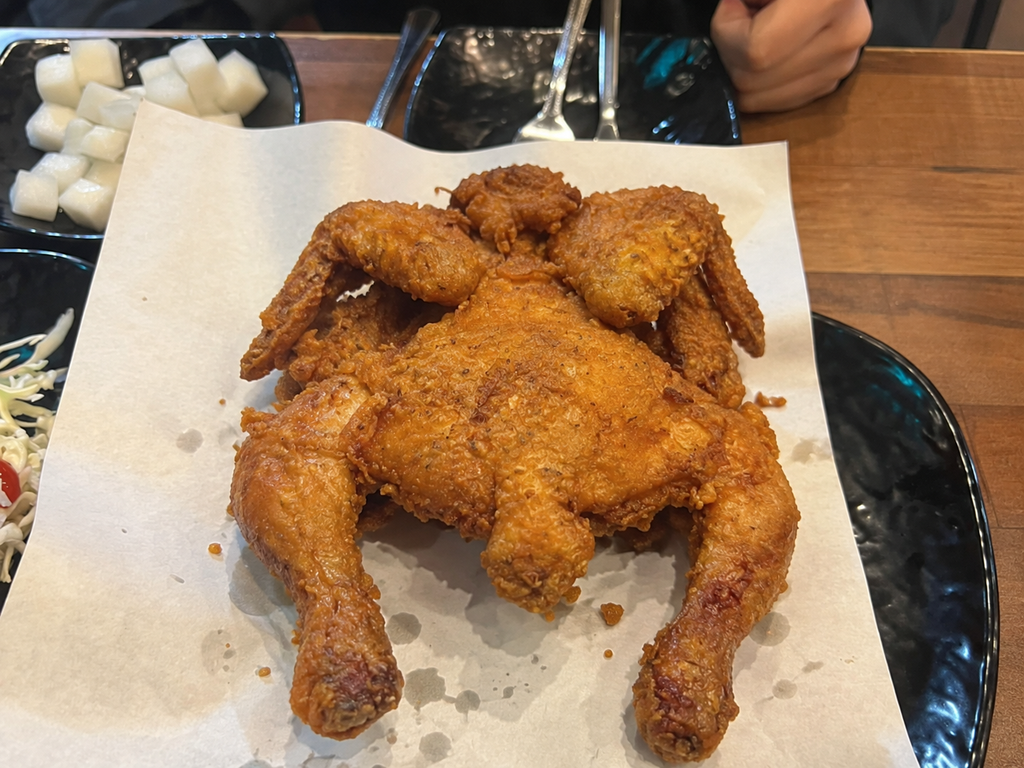
Tongdak (통닭) literally refers to a whole chicken.
In current food conversations, yetnal tongdak—old-school chicken—usually means a relatively small bird fried whole or split open, with a thin coating and straightforward seasoning.
It is often cut into pieces after frying and served with salt or sauce on the side.
This is not simply modern franchise chicken served in a different box.
Contemporary Korean fried chicken is commonly sold as separately cut pieces with a thicker, craggier crust designed to hold sauce.
Tongdak puts more attention on crisp skin, the flavor of the chicken, and the slightly hands-on business of finding each piece.
You are more likely to see this style at traditional markets and older neighborhood chicken shops.
Korea Tourism Organization’s guide to fried chicken in Daegu also distinguishes whole fried chicken from the later style of frying individual pieces.
Good for: travelers who want a retro Korean food experience and do not mind bone-in chicken.
The catch: a whole bird can be awkward to eat, and the meat-to-bone ratio varies with its size.
Eat it fresh. Thin, crisp skin loses its best feature when trapped in a steamy bag for too long.
2. Classic Fried Chicken
Plain fried chicken, often written as 후라이드, is the sauce-free baseline.
Pieces are battered or breaded, deep-fried, and usually seasoned with salt or a light spice blend.
Recipes differ, but the point is the crust: no glaze covering it and no powder competing for attention.
This is the safest choice for someone who already likes fried chicken and wants to understand the crisp texture Korean chicken shops are known for.
It also travels better than heavily sauced versions, although any fried chicken softens in a closed takeout box.
Plain fried chicken is frequently paired with yangnyeom in a half-and-half order because the two show opposite sides of the menu:
maximum crunch versus maximum sauce.
If you dislike sweet main dishes, start here rather than ordering whichever flavor has the loudest menu photo.
3. Yangnyeom Chicken
Yangnyeom chicken (양념치킨) is fried chicken coated in a sticky seasoned sauce.
A common flavor profile combines sweetness, gentle heat, tanginess, and garlic, but there is no single universal formula.
Some sauces lean sweeter and more tomato-like, while others taste more strongly of gochujang, chili, or garlic.
Despite the red color, not every yangnyeom chicken is seriously spicy.
Many standard versions are built around a sweet-spicy balance rather than extreme heat.
Still, menu names such as hot, fire, volcano, or Korean words indicating spicy flavors are worth checking if you have a low spice tolerance.
Yangnyeom is one of the defining Korean chicken styles and a good first order because it tastes clearly different from plain fried chicken.
The tradeoff is simple: once sauce covers the crust, some of the crunch disappears.
And yes, your fingers will probably end up sticky.
The Academy of Korean Studies describes yangnyeom chicken as fried chicken coated in a sauce commonly built from ingredients such as chili paste, soy sauce, and syrup, although individual restaurants use their own recipes.
4. Soy Garlic Chicken
Soy garlic chicken uses a soy sauce-based glaze with garlic and sweetness.
Compared with standard yangnyeom, it is usually less chili-forward, darker in color, and more savory.
It can still be sweet—sometimes more than visitors expect—but the overall direction is salty-sweet and garlicky rather than red, tangy, and spicy.
For travelers who avoid heat, this is often one of the easiest flavored options.
It also works well with wings because the thinner glaze can coat the skin without completely hiding the fried texture.
Check the menu carefully, though.
Soy, garlic soy, and soy garlic do not always mean exactly the same recipe, and some shops sell both mild and spicy soy-based versions.
Yangnyeom vs soy garlic: choose yangnyeom for sweet heat and tang; choose soy garlic for savory sweetness and garlic.
5. Honey or Sweet-Style Chicken
Honey-style chicken is for people who prefer mild sweetness over chili heat.
Depending on the restaurant, that sweetness may come from a glaze, light coating, or sweet-savory seasoning.
The name does not mean every recipe uses honey in exactly the same way.
Treat it as a menu style rather than one standardized Korean recipe.
If ingredients or allergens matter to you, check the restaurant’s current description.
Flavor-wise, these menus tend to be beginner-friendly, although anyone who dislikes sweet meat may prefer soy garlic or classic fried chicken.
6. Cheese Powder or Snowing-Style Chicken
This category covers fried chicken coated with a fine flavored powder.
Cheese is common, often mixed into a sweet-savory seasoning that may also include onion, dairy ingredients, or other flavorings.
Unlike a wet glaze, the powder stays on the outside of the crust.
It is very snack-like and firmly part of modern Korean franchise chicken culture.
It is also intense.
The powder sticks to your fingers, gathers at the bottom of the box, and can taste sweeter than English-speaking visitors expect from something labeled “cheese.”
Many names in this category are brand trademarks, so cheese powder chicken or powder-seasoned chicken works better as a general description than using one company’s product name for the entire style.
Try it if: you like cheese-flavored snacks and bold sweet-savory seasoning.
Skip it if: you mainly want a clean, savory fried-chicken flavor.
7. Green Onion Chicken (Padak)
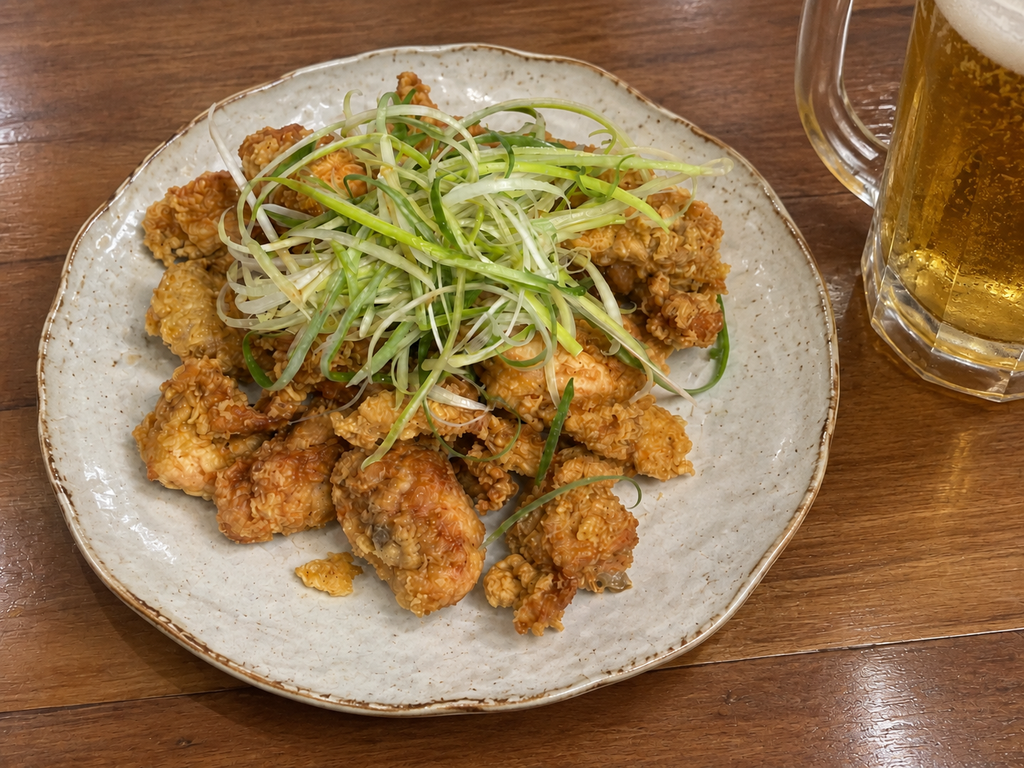
Padak (파닭) combines pa, meaning green onion, with chicken.
Thinly sliced green onion is piled over or served beside fried chicken, often with a mustardy, soy-based, or slightly sweet dressing.
You eat the fresh onion together with the chicken.
The appeal is the contrast.
Fried chicken is hot and rich, while shredded green onion is cool, sharp, and crunchy.
It can make a full chicken order feel less heavy, although the raw-onion bite is definitely part of the experience.
If you are ordering takeout, ask whether the onion and dressing can be packed separately.
That helps keep the crust from becoming soggy before you eat it.
VisitKorea’s overview of Korean fried chicken also identifies chicken with sliced green onions as a popular Korean chicken style.
8. Garlic Chicken
Garlic chicken is a broader category than soy garlic chicken.
One restaurant may use a soy-based garlic glaze.
Another might add fried garlic chips, minced garlic sauce, or a pale creamy garlic topping.
The Korean word maneul (마늘) tells you garlic is central to the dish, but not whether the final flavor will be sweet, spicy, creamy, or soy-based.
If the menu says ganjang maneul (간장마늘), soy sauce is likely part of the flavor profile.
If it only says garlic or maneul, check the description or ask whether the sauce is sweet or spicy.
That small question can prevent a very large box of surprises.
9. Spicy Korean Chicken
“Spicy chicken” is not one fixed recipe.
It may mean a hotter version of yangnyeom, a chili-heavy soy glaze, a dry seasoning, or oven-roasted chicken with a spicy sauce.
Heat levels vary widely between brands and even between menu lines at the same chain.
Do not assume every red chicken is extremely hot.
Also do not assume a cute menu photo means the spice level is mild.
Look for chili icons and Korean words such as maeun (매운, spicy) or bul (불, fire).
If you are unsure, you can ask:
“Igeo mani maewoyo?”
이거 많이 매워요?
“Is this very spicy?”
If a restaurant allows sauce on the side, that can also make the spice level easier to control.
10. Oven-Roasted Chicken
Oven-roasted chicken has its own place in Korea’s chicken market.
Instead of being submerged in frying oil, the chicken is cooked in an oven, so it does not have the same battered, deep-fried shell.
Depending on the menu, it may be plain roasted chicken, crisp-skinned pieces, or chicken finished with sauce.
This is a useful option for someone who wants chicken-shop flavors without a thick fried coating.
That does not automatically make it “light” or low-calorie.
Sauces, skin, portion size, and side dishes still matter.
The useful distinction is the cooking method, not a health claim.
Current Korean menus continue to treat oven-roasted chicken as its own category, as shown by the official product information from the company behind Goobne Chicken.
Yangnyeom vs Soy Garlic vs Fried Chicken
Among the most common Korean fried chicken types, these three are the easiest to compare because the biggest difference is how the crust and sauce work together.
| Feature | Classic Fried | Yangnyeom | Soy Garlic |
|---|---|---|---|
| Sauce | None or seasoning only | Red or reddish seasoned glaze | Soy-based brown glaze |
| Sweetness | Low to moderate | Usually moderate to high | Usually moderate |
| Spiciness | Usually mild | Mild to hot, depending on menu | Usually mild, but exceptions exist |
| Garlic flavor | Recipe-dependent | Often present in the background | Usually more noticeable |
| Crispiness | Highest when fresh | Softer where sauce coats the crust | Often between fried and yangnyeom |
| Messiness | Lowest | Highest | Moderate |
| Best for | Crunch and simple flavor | Sweet-spicy sauce lovers | Savory-sweet flavor without much heat |
| Beginner-friendly | Very high | High at standard heat | Very high for most non-spicy eaters |
These are general tendencies, not guarantees.
One restaurant’s soy chicken can be sweeter than another restaurant’s yangnyeom.
That is why the menu description matters more than the category name alone.
What Is Banban Chicken?
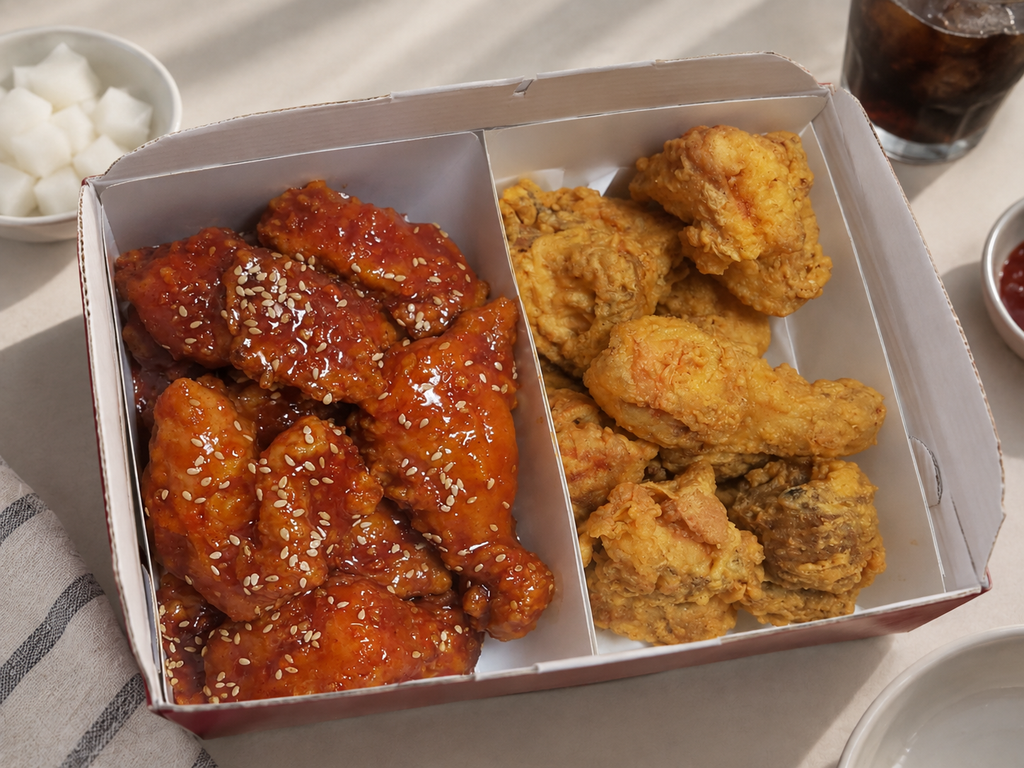
Banban (반반) means half and half.
The classic combination is half plain fried and half yangnyeom, although many restaurants allow other pairings such as soy garlic with spicy chicken.
It is one of the easiest orders for first-time visitors because you can compare two flavors without buying two full chickens.
Available combinations and extra charges vary by restaurant.
Some places let you combine almost any two flavors.
Others offer only fixed half-and-half combinations, and some do not offer banban at all.
Popular Korean Fried Chicken Sides
Korean chicken orders often come with or offer a surprisingly large side menu.
Not every restaurant includes the same items, so check what actually comes with your order before adding extras.
Chicken Mu
Chicken mu (치킨무) is cubed pickled radish with a sweet-and-sour flavor.
Its cold crunch helps cut through fried food and sticky sauces between bites.
It is commonly included with Korean chicken orders, although portion size and extra charges depend on the shop.
French Fries
Fries often appear in sets or as separate side orders.
They are not automatically included with every chicken order.
Check whether the photo you are looking at shows a set menu or chicken only.
Cheese Balls
Cheese balls are round fried snacks with cheese or a cheese-flavored filling inside.
They are now common add-ons at large Korean chicken chains.
Texture, sweetness, cheese content, and serving size vary widely.
Official menus from chains such as Kyochon show that cheese-ball sides remain a common part of modern Korean chicken menus.
Sotteok-Sotteok and Rice Cakes
Sotteok-sotteok combines sausage and rice cake on a skewer, usually with sweet-spicy sauce.
Some chicken chains sell it as a side, although it is far from universal.
Rice cakes may also appear inside sauced chicken dishes or as separate add-ons.
Cabbage Salad and Corn Salad
Shredded cabbage with creamy or ketchup-based dressing has a particularly old-school chicken-shop feel.
Corn salad also appears at some chains and retro-style restaurants.
Do not assume either one will automatically come with your order.
Dipping Sauces
Salt, mustard, spicy sauce, cheese-flavored dip, and house seasonings may be included or sold separately.
If one sauce matters to you, check the takeout bag before leaving.
Finding out later that the mustard stayed at the counter is a very small problem, but still an annoying one.
What Is Chimaek?
Chimaek (치맥) is a combination of chi from chicken and maek from maekju (맥주), the Korean word for beer.
The term refers to the well-known Korean pairing of fried chicken and beer, often associated with casual group meals, sports viewing, and picnics.
Alcohol is not required to enjoy Korean chicken culture.
Soft drinks, sparkling water, or other non-alcoholic drinks are common alternatives, and anyone under the legal drinking age should choose a non-alcoholic option.
VisitKorea also defines chimaek as the chicken-and-beer combination in its official fried chicken guide.
How Korean Chicken Is Usually Ordered
- One chicken / han mari (한 마리): usually one full chicken portion cut into pieces; exact size varies.
- Bone-in / ppyeo (뼈): chicken pieces with bones.
- Boneless / sunsal (순살): bite-size boneless pieces; the cut of meat depends on the brand and product.
- Banban (반반): two flavors in one order when available.
- Wings, drumsticks, or combo: some menus let you order specific cuts.
- Dine-in: best when you want the chicken as crisp as possible.
- Takeout / pojang (포장): often easy for travelers staying in hotels.
- Delivery / baedal (배달): widely used in Korea, although app access, payment methods, and minimum orders can vary.
For travelers who are nervous about ordering, a photo menu plus two decisions—bone-in or boneless, then flavor—will handle most of the process.
MBK’s guide to where to eat alone in Myeongdong also covers easier solo meal options when a full chicken feels like too much food.
Bone-In vs Boneless Korean Chicken
Bone-in chicken gives you a mix of cuts and often stays juicy, but it is messier and slower to eat.
Boneless chicken is easier to share and much easier to handle in a hotel room.
But sunsal does not mean one universal cut of meat.
One brand may use thigh meat.
Another may use breast.
A particular menu item may even use a different cut from the rest of the brand’s boneless chicken.
If it matters to you, check the current menu or ask:
“Sunsal-eun dari-sal-ieyo, gaseum-sal-ieyo?”
순살은 다리살이에요, 가슴살이에요?
“Is the boneless chicken thigh meat or breast meat?”
Do not assume boneless chicken is automatically a smaller or better-value order.
Compare the listed weight or piece count when available.
Useful Korean Words for Ordering Chicken
| Korean | Pronunciation | Meaning |
|---|---|---|
| 후라이드 | hu-ra-i-deu | Plain fried chicken |
| 양념 | yang-nyeom | Seasoned sauce; for chicken, usually sweet-spicy |
| 간장 | gan-jang | Soy sauce |
| 마늘 | ma-neul | Garlic |
| 매운맛 | mae-un-mat | Spicy flavor |
| 순살 | sun-sal | Boneless |
| 뼈 | ppyeo | Bone-in |
| 반반 | ban-ban | Half and half |
| 한 마리 | han ma-ri | One whole chicken portion |
| 치킨무 | chi-kin-mu | Pickled radish served with chicken |
| 포장 | po-jang | Takeout |
| 배달 | bae-dal | Delivery |
| 여기서 먹을게요 | yeo-gi-seo meo-geul-ge-yo | I’ll eat here |
Common Mistakes First-Time Visitors Make
Assuming all yangnyeom is extremely spicy.
Many versions are more sweet than fiery, while specially labeled hot versions can be much stronger.
Expecting every restaurant to sell every flavor.
Independent shops and specialist chains can have very different menus.
Assuming boneless always means thigh meat.
The cut depends on the company and menu item.
Using tongdak and modern franchise chicken as exact synonyms.
In everyday use, old-school tongdak often refers to a whole, thinner-coated retro style.
Ordering several sides before checking the chicken portion.
A full chicken order is often designed to share.
Assuming banban is always available.
Some restaurants restrict the flavors that can be combined.
Trusting an old delivery-app screenshot.
Menus, prices, portion sizes, and branch availability change.
Which Korean Chicken Should You Order First?
If this is your first Korean chicken meal, plain fried plus standard yangnyeom in a banban order is one of the easiest introductions.
If you dislike spicy food, start with classic fried, soy garlic, or a mild sweet-style menu.
If garlic is the reason you opened the menu in the first place, go with soy garlic or a dedicated garlic chicken.
For a more old-school Korean experience, try whole tongdak at a market or retro-style chicken shop.
If you want something less familiar outside Korea, padak or powder-seasoned chicken is worth looking for.
There is no one flavor that works for everyone.
Start with the contrast you care about most:
crispy or saucy, mild or spicy, familiar or something you probably do not order at home.
FAQ
What is the most popular type of Korean fried chicken?
There is no single current official nationwide winner.
Classic fried chicken and yangnyeom are two of the foundational styles found across many Korean chicken menus, while soy garlic is another widely available option.
What is yangnyeom chicken?
Yangnyeom chicken is fried chicken coated in a seasoned sauce that is commonly sweet, sticky, tangy, garlicky, and mildly to strongly spicy.
The recipe and heat level vary by restaurant.
Is Korean fried chicken spicy?
Not necessarily.
Plain fried chicken, many soy garlic menus, and some sweet-style options are mild.
Yangnyeom ranges from mildly spicy to hot, so check chili symbols and menu descriptions.
What is Korean tongdak?
Tongdak literally refers to a whole chicken.
In an old-school chicken-shop context, it commonly refers to a smaller whole bird fried with a relatively thin coating, rather than modern thick-crusted franchise pieces.
What is banban chicken?
Banban means half and half.
A common order combines plain fried and yangnyeom chicken, although the available combinations depend on the restaurant.
What is chicken mu?
Chicken mu is cubed Korean pickled radish served cold with fried chicken.
Its sweet-and-sour flavor and crisp texture help balance fried or saucy chicken.
What is the difference between fried and yangnyeom chicken?
Classic fried chicken is sauce-free and usually stays crispest.
Yangnyeom starts with fried chicken and adds a sticky seasoned sauce, giving it more sweetness, tang, and possible heat but slightly less crunch.
What is soy garlic chicken?
Soy garlic chicken is fried chicken coated with a soy sauce-based garlic glaze.
It is generally savory-sweet and less chili-forward than standard yangnyeom, although recipes vary.
What is chimaek?
Chimaek is a Korean word combining chicken and maekju, meaning beer.
It describes the cultural pairing of fried chicken and beer, although alcohol is completely optional.
Can you order Korean fried chicken for one person?
Yes, but full chicken portions are often designed for sharing.
Look for smaller portions, wings, half orders, boneless sets, or smaller market-style tongdak when available.
Sources & Last Updated
The food categories and cultural terms in this guide were checked against:
- VisitKorea: Fried Chicken
- VisitKorea: Fried Chicken in Daegu
- Encyclopedia of Korean Culture: Chicken
- Kyochon Official Website
- GN Food Official Website
Last updated: September 19, 2026.
Menus, ingredients, portion sizes, side dishes, prices, and branch availability can change.
Check the restaurant’s current official menu, especially if spice level, allergens, meat cut, or a particular half-and-half combination matters to you.