
Korean convenience stores are more than places to grab chips and soda. Depending on the branch, you can buy a full meal, heat it up, prepare instant noodles, make an ice-cup drink and handle a few everyday errands without leaving the store.
That combination is what often surprises first-time visitors. It is not that every Korean convenience store is enormous or packed with viral food. Most are small neighborhood shops. They simply do more with the space they have.
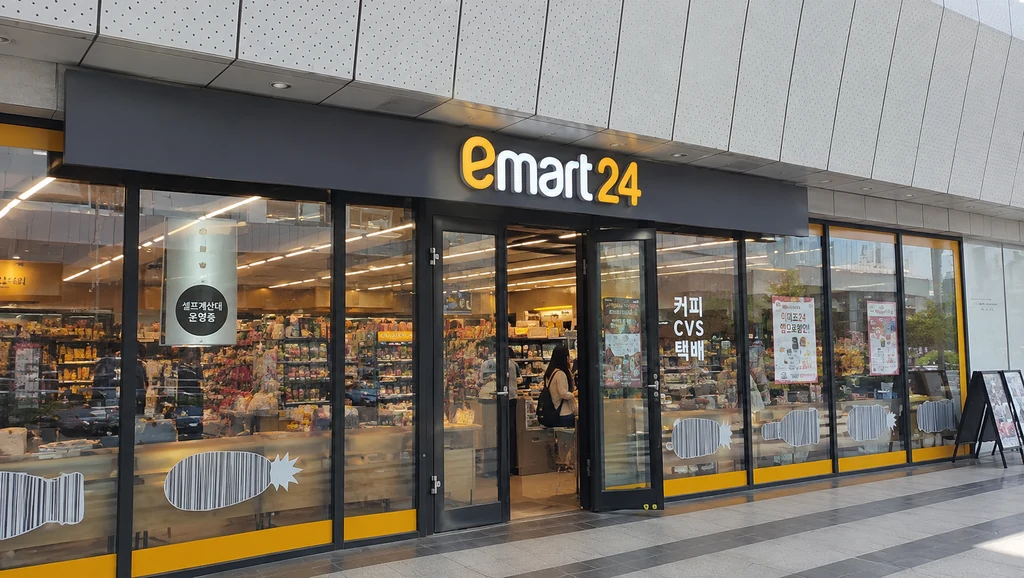
Why Do Korean Convenience Stores Feel So Different?
They often work as several places at once: a small grocery store, a quick-meal counter, a late-night snack stop and a neighborhood service point.
Prepared meals take up serious shelf space. Microwaves and hot-water dispensers let customers eat immediately. Monthly 1+1 and 2+1 promotions are easy to spot. Private-label products and short-run collaborations give each chain its own changing lineup.
Store density matters too. According to the April 2026 issue of the official KOREA webzine, Korea’s four major chains had a combined 53,266 stores at the end of 2025. That was roughly one store per 900 people. A convenience store is often simply the closest useful shop.
The key word is often—not always.
A compact branch near an office may have no seats. A large tourist-area store may have a ramen station, tables and shelves of souvenirs. They are both normal Korean convenience stores.
They Are Part of Everyday Korean Life
For local customers, a convenience store can solve a very ordinary problem: breakfast before work, a drink between appointments, toothpaste after the shops have closed or dinner when cooking feels like too much effort.
That does not mean everyone in Korea eats convenience-store meals every day. It means the stores are built around frequent, small needs. Their food and services reflect the rhythms of neighborhoods, subway stations, universities, offices and residential areas.
This is also why the same chain can look different from one block to the next. A branch near a school may emphasize snacks and drinks. One beside an office district may carry more lunch boxes and coffee. A tourist-heavy location may stock Korean souvenir foods, multilingual signs or tax-refund facilities.
Yes, You Can Eat a Full Meal There
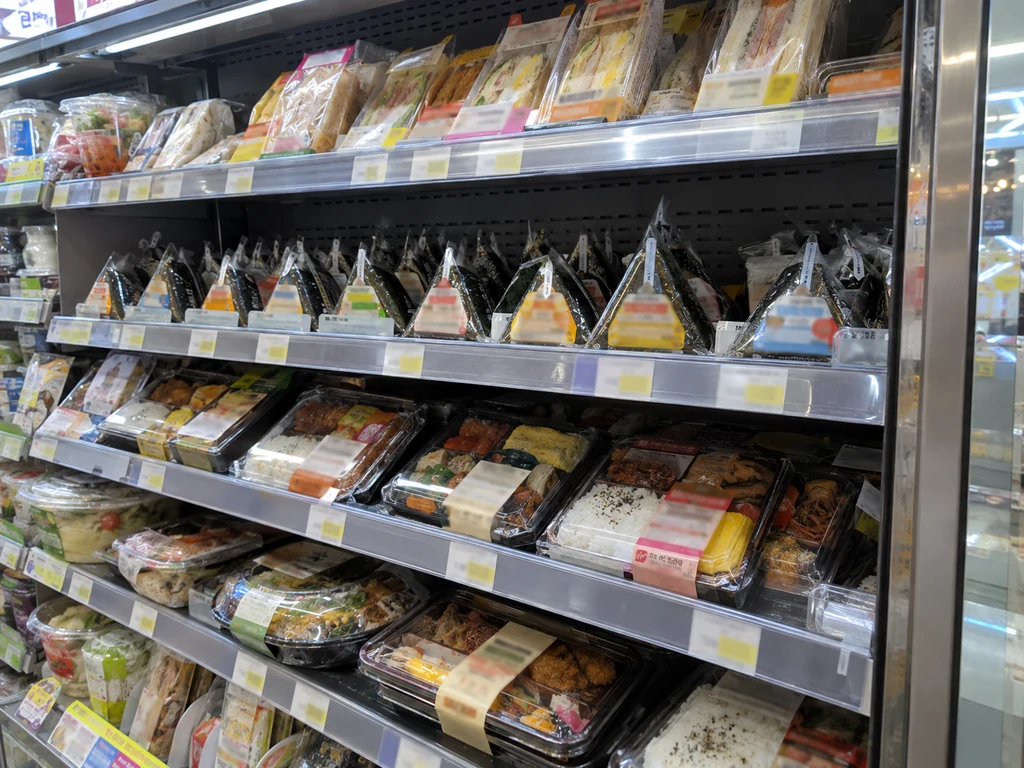
The prepared-food refrigerator is usually where the experience starts.
Common categories include:
- Dosirak (도시락): boxed meals with rice and several side dishes
- Samgak gimbap (삼각김밥): triangular rice snacks with a filling
- Gimbap (김밥): sliced or whole seaweed rice rolls
- Sandwiches and burgers
- Rice bowls, pasta and refrigerated noodle dishes
- Salads, fruit cups and simple protein snacks
- Cup noodles and packet ramyeon
- Hot-bar snacks, dumplings or fried foods, depending on the branch
A convenience-store meal is useful when you need something quick, inexpensive and uncomplicated.
It is less useful if you want a leisurely restaurant meal, a large menu or help with dietary restrictions. Ingredient labels are usually in Korean, and allergen information may not be obvious to a visitor.
How Korean Convenience Store Ramyeon Works
Videos often make the process look universal: pick packet noodles, place them in a foil bowl, press a button and eat beside the machine.
That setup exists, especially at larger branches and stores near popular picnic areas, but it is not standard in every shop.
At a regular branch, the process is usually simpler:
- Choose cup noodles or an item specifically designed for the store’s cooking setup.
- Pay before opening it.
- Use the hot-water dispenser or ramen cooker provided by that branch.
- Follow the instructions on the package or machine.
- Eat only in an area where the store allows it.
If there is no obvious cooking station, do not assume a random container can go into the microwave.
Ask first.
Metal-lined packaging and sealed containers may be unsafe to heat.
The Han River Version
Ramyeon beside the Han River is a popular picnic experience.
Some nearby stores sell packet noodles with disposable cooking bowls and provide special machines with picture instructions.
Facilities and rules still vary by park and store, so buy the noodles where you plan to cook them and follow that location’s directions.
Why Are There Microwaves and Hot-Water Machines?
They are there because much of the food is designed to be eaten right away.
A microwave turns a refrigerated rice bowl into lunch; hot water turns cup noodles into a late-night meal.
Some machines are self-service. At other stores, the cashier may help or the microwave may be behind the counter.
Check the package time instead of guessing.
A small meal can become a very smoky experiment surprisingly fast.
What Is an Ice-Cup Drink?
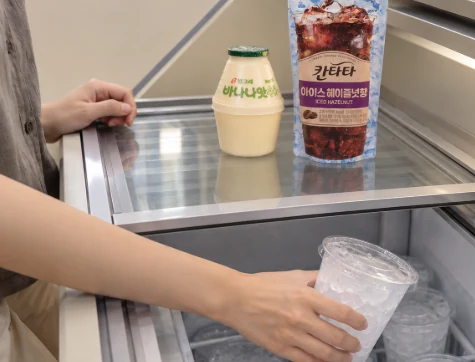
If you see sealed plastic cups filled only with ice in a freezer, nothing is missing.
The drink is sold separately.
Choose the correct cup size, pick a pouch or bottled drink that matches it, pay for both and pour the drink over the ice.
Coffee is common, but stores may also offer juice, tea or seasonal beverages in this format.
Cup sizes and eligible drinks differ, so match the labels rather than choosing by eye.
The ice cup and drink are normally scanned as separate items.
What Do 1+1 and 2+1 Mean?
The signs are simple once you know the code:
1+1: Buy one eligible item and receive one additional eligible item.
2+1: Buy two eligible items and receive one additional eligible item.
It is similar to a BOGO promotion, but you need to check the exact shelf label.
The offer may apply only to a particular size, flavor or group of products.
Do not grab any two drinks from the same refrigerator and assume they qualify.
The cashier will usually scan every item, including the free one. Bring all the items to the counter at the same time.
If you are not sure, point to the sign and ask:
“Igeo won-peul-won majayo?”
“Is this 1+1?”
Can You Save the Extra Item for Later?
Some chain apps let registered users store an unclaimed promotional item digitally and collect it later.
GS25’s Our Neighborhood GS app, for example, includes its “My Fridge” storage function.
For a short-term visitor, this may be more trouble than it is worth.
App language, account registration, phone verification and pickup conditions can be barriers.
Unless you already use the app, the easiest option is to take all the promotional items at checkout or skip the deal.
CU vs GS25 vs 7-Eleven vs emart24
CU, GS25, 7-Eleven and emart24 are the four names visitors are most likely to notice.
There is no need to plan your day around finding one “best” chain.
For most travelers, the branch itself matters more than the logo.
| Brand | What You Will Commonly Find | Useful Distinction | What Varies |
|---|---|---|---|
| CU | Prepared meals, snacks, drinks, monthly promotions and exclusive products | Pocket CU supports stock checks and pickup-related features; some branches specialize in K-food or ramyeon | Seating, cooking equipment, tax refund, stock and services |
| GS25 | A broad ready-to-eat range, desserts, drinks and collaboration products | Our Neighborhood GS includes inventory, ordering and “My Fridge” functions | App usability for visitors, seating, stock and branch services |
| 7-Eleven Korea | Prepared food, snacks, drinks and chain-exclusive releases | Familiar global name, but the Korean product mix is local | Store size, hot-food selection, seating and services |
| emart24 | Meal items, snacks, drinks and private-label or exclusive products | Some larger concept branches emphasize K-food, desserts or lifestyle goods | Themed features, seating, cooking equipment and inventory |
Two branches of the same chain can differ more than two competing stores across the street.
If you want a seat, ramen cooker, ATM, parcel service or tax refund, check the branch rather than relying on the brand name.
Private-Label Products and Collaborations Keep Changing the Shelves
Each chain uses private-label products, exclusives and collaborations to stand out.
This is why a snack seen in a video may not exist at the next store—or may be gone by the time you arrive in Korea.
Recent examples show how quickly the mix moves.
CU launched Little RIIZE character foods and a pop-up in June 2026.
GS25 released a frozen yogurt chapssaltteok collaboration with the Korean dessert brand Hanjeongseon in September 2026.
emart24 also expanded its Dubai-style sandwich and cream-bread line during the first half of 2026.
These examples explain the culture; they are not a shopping guarantee.
Collaboration products can be limited, seasonal or sold out.
If one item is the sole reason for your visit, check the chain’s app or a recent official post first.
These examples were checked in September 2026 and are included to show how quickly convenience-store shelves change, not as a current availability list.
Desserts, Coffee and Drinks Are a Large Part of the Experience
The dessert shelf can include cream breads, small cakes, puddings, ice cream, rice-cake desserts and seasonal fruit products.
The exact viral item changes quickly, but the category itself is not a passing trend.
Drinks take up just as much attention.
Expect canned and bottled coffee, milk drinks, energy drinks, traditional-style beverages, pouches for ice cups and rotating seasonal flavors.
This is one area where browsing works better than arriving with a rigid list.
Check the date, storage instructions and whether the product needs refrigeration.
A cream-filled souvenir is much less charming after a long summer train ride.
Convenience Stores Sell More Than Food
Food gets the videos, but daily services explain why these stores matter locally.
Depending on the branch, you may find:
- An ATM or cash-withdrawal terminal
- Parcel drop-off or pickup
- T-money card sales or recharging
- Shared power-bank rental or charging accessories
- Printing, copying or photo services
- Umbrellas, toiletries, sanitary products and basic stationery
- Utility-bill payment and other services mainly used by residents
CU’s official store finder, for example, lets users filter locations by services such as 24-hour operation, parcel service, ATMs, shared batteries and unmanned printing.
The existence of those filters is also a useful reminder: no single service is guaranteed at every branch.
Can You Buy or Recharge T-Money There?
Major convenience-store chains commonly sell and recharge T-money transportation cards, although card designs and stock vary.
Ask at the counter if you do not see them displayed.
Bring Korean won in cash for recharging.
T-money’s official foreigner guide specifies cash for top-ups, so do not rely on a foreign credit card for this step.
The card purchase and the balance loaded onto it may also be handled separately.
Can Foreign Tourists Pay by Card or Cash?
Cards are widely accepted in Korea, including for small convenience-store purchases.
International Visa or Mastercard cards often work, but no foreign card is guaranteed at every terminal.
Keep another card or a little Korean cash as backup.
Cash is still accepted at ordinary staffed convenience stores.
It is also useful for T-money recharging.
Unstaffed or late-night self-checkout operations may have different payment rules, so follow the screen or ask the staff member on duty.
Do Convenience Stores Offer Tax Refunds?
Some do.
Korea Tourism Organization information updated in February 2026 says eligible foreign visitors can receive an instant VAT refund at CU and GS25.
In practice, treat this as a participating-branch service, not a promise that every location can process it.
Look for tax-refund signage and have your passport ready.
Eligibility, minimum spending rules and system availability can change, so confirm before paying if the refund matters to your purchase.
For a drink and a triangle gimbap, it is usually not worth turning checkout into an accounting project.
Can You Eat Inside? Are Stores Open 24 Hours?
Sometimes, and many are—but neither is universal.
A branch may have indoor seats, outdoor tables or no dining area at all.
Stores inside office buildings, subway facilities or malls may follow the building’s hours.
Independent franchise locations can also have different operating schedules.
Check Naver Map or the chain’s store finder for current hours, then look at the actual space before opening your meal.
Outdoor tables can also be unavailable because of weather, local rules or building policy.
Why Your Store May Not Look Like the Viral Videos
The huge ramen libraries, riverside cooking stations and stores with long rows of tables are memorable precisely because they are unusual.
They should not be treated as the standard branch design.
Most neighborhood stores are tighter.
You may find one microwave, a hot-water dispenser and no place to sit.
Inventory also reflects local demand, delivery timing and store size.
If a famous dessert is missing, another branch may have it—or the trend may simply have moved on.
What a First-Time Visitor Should Actually Do
You do not need a complicated convenience-store bucket list.
Try this instead:
- Browse the prepared-food refrigerator before choosing a snack
- Check the exact 1+1 or 2+1 shelf label
- Try an ice-cup drink if the size pairing is clear
- Read the heating instructions before using the microwave
- Ask whether eating is allowed before opening the package
- Look at the current seasonal or collaboration shelf, but do not expect an old viral item
That is enough to understand why tourists enjoy Korean convenience stores.
The appeal is not one perfect snack.
It is how many small parts of daily life fit into one ordinary shop.
Useful Korean Convenience Store Words
| Korean | Meaning |
|---|---|
| 편의점 (pyeonuijeom) | Convenience store |
| 도시락 (dosirak) | Boxed meal |
| 삼각김밥 (samgak gimbap) | Triangular rice snack |
| 컵라면 (keop-ramyeon) | Cup noodles |
| 봉지라면 (bongji-ramyeon) | Packet instant noodles |
| 얼음컵 (eoreum-keop) | Ice cup |
| 전자레인지 (jeonja-reinji) | Microwave |
| 온수 (onsu) | Hot water |
| 행사상품 (haengsa sangpum) | Promotional item |
| 증정 (jeungjeong) | Free promotional item |
| 품절 (pumjeol) | Sold out |
| 재고 (jaego) | Stock |
| 봉투 (bongtu) | Bag |
Useful phrases:
이거 1+1 맞아요?
(Igeo won-peul-won majayo?)
Is this part of the 1+1 promotion?
전자레인지 어디 있어요?
(Jeonja-reinji eodi isseoyo?)
Where is the microwave?
여기서 먹어도 돼요?
(Yeogiseo meogeodo dwaeyo?)
Can I eat here?
이거 어떻게 데워요?
(Igeo eotteoke dewoyo?)
How do I heat this?
Common Mistakes to Avoid
- Opening food before paying
- Assuming every branch has seating or a ramen cooker
- Taking a different size or flavor under a 1+1 sign without checking eligibility
- Heating a package without reading its instructions
- Expecting an old TikTok product to remain in stock
- Assuming every location is open 24 hours
- Expecting every branch to offer tax refunds, parcel service or an ATM
- Relying on one foreign card with no backup payment method
Why They Become Part of the Korea Travel Experience
Korean convenience stores are not theme parks disguised as grocery shops.
They are everyday spaces that visitors can understand almost immediately.
You can see what people grab for a quick lunch, how promotions are displayed, which flavors are having a moment and what a neighborhood needs after dark.
Few parts of ordinary Korean life are this easy for a traveler to step into.
Go in hungry if you like.
Just do not expect every branch to come with a river view and a wall of 200 noodle varieties.
Frequently Asked Questions
Why are Korean convenience stores popular with tourists?
They combine prepared meals, self-service heating, frequent promotions, changing exclusive products and everyday services in small, easy-to-find shops.
What are the main convenience-store brands in Korea?
CU, GS25, 7-Eleven Korea and emart24 are the four major chains most visitors will see.
Can you eat a meal at a Korean convenience store?
Yes.
Boxed meals, gimbap, triangle gimbap, sandwiches, noodles and other prepared foods are common.
Seating is not guaranteed.
Can you cook ramyeon inside the store?
At branches with hot water or a dedicated ramen cooker, yes.
Pay first, use the correct container and follow the store’s instructions.
What does 1+1 mean in Korea?
It means you buy one eligible promotional item and receive one additional eligible item.
Bring both to the cashier.
What does 2+1 mean?
Buy two eligible items and receive one additional eligible item.
Check the exact product, size and flavor listed on the sign.
What is an ice-cup drink?
It is a sealed cup of ice sold separately from a pouch or bottled drink.
You pay for both and pour the drink over the ice.
Can you eat inside convenience stores in Korea?
Only where seating or a designated eating area is available.
Some branches have tables; others do not allow on-site eating.
Are Korean convenience stores open 24 hours?
Many are, but not all.
Locations inside other buildings and some franchise branches follow shorter hours.
Can tourists use foreign credit cards?
Foreign Visa and Mastercard cards often work, but acceptance is not guaranteed at every terminal.
Carry a backup card or some Korean cash.
Can you buy or recharge T-money at convenience stores?
Major chains commonly sell and recharge T-money cards.
Stock varies, and you should bring Korean won in cash for recharging.
What is the difference between CU and GS25?
Both offer broad prepared-food ranges, promotions, apps and exclusive products.
For a traveler, differences between individual branches are often more important than the chain name.
Do all Korean convenience stores sell the same products?
No.
Inventory changes by chain, branch size, neighborhood, season, delivery timing and current collaborations.
Do convenience stores in Korea offer tax refunds?
Participating CU and GS25 branches can provide instant VAT refunds to eligible foreign visitors.
Check for signage and confirm before paying.
Sources & Last Updated
Key information in this guide was checked against current or official sources including:
- KOREA webzine, April 2026 — convenience-store industry figures
- CU official store finder and service filters
- GS25 / Our Neighborhood GS official app information
- T-money official foreigner guide
- Korea Tourism Organization — tourist tax-refund information
- 2026 collaboration announcements: CU / BGF — Little RIIZE collaboration, June 2026; GS Retail press release — Hanjeongseon yogurt chapssaltteok, September 2026; emart24 / Shinsegae — Dubai-style sandwich products, February 2026; emart24 / Shinsegae — Dubai-style cream bread, February 2026
Last updated: October 10, 2026
Store hours, product availability, promotions, tax-refund service, seating, cooking equipment and branch services can change.
Check the exact branch or official app before making a special trip.